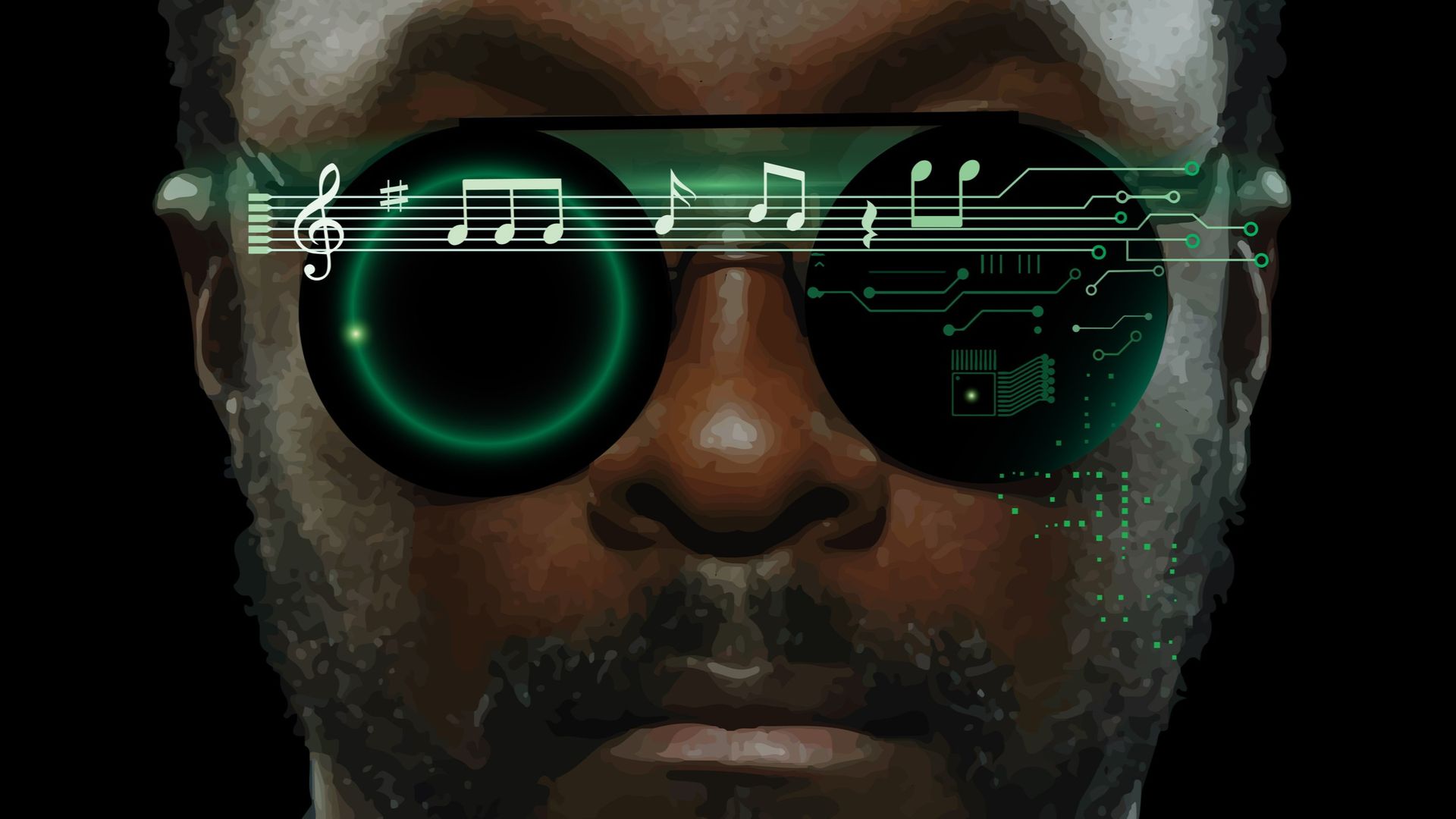
Will.i.am, the Grammy-award winning rapper from the Black Eyed Peas group, has long mesmerised millennials with his music. This week, however, he grabbed the attention of economists, government ministers and corporate leaders with a different tune — a vision for artificial intelligence.
As debates about AI dominated this year’s World Economic Forum meeting in Davos, will.i.am was among the loudest extolling the technology’s putative power.
That is partly because it is sparking his own creativity (this week he launched the first music radio show with a bot). However, there is another reason too. He thinks AI could pull marginalised people into the mainstream economy in future years, and thus be a tool for social levelling. In particular, he told me — in a lively, expletive-laden speech on stage — he thinks AI will “break down barriers” for people “who have nothing”, in a near-unprecedented way.
Is this just another bit of Davos hype? Many might think so. It is true that in recent months a host of economists have predicted that AI will deliver a big boost to growth. Michael Spence, a Stanford university professor, for example, thinks it will add at least $4tn annually to global gross domestic product.
But this chatter about a putative productivity miracle usually occurs amid fears about rising social inequalities, due to the displacement of jobs. Indeed, at the start of this week’s WEF meeting, a survey from PwC revealed that a quarter of global chief executives expect generative AI to lead to headcount reductions of at least 5 per cent this year. Meanwhile, the IMF predicted that AI will change 40 per cent of all global jobs — and 60 per cent of those affected will be in developed countries.
More alarming still, there is a widening “digital divide” in terms of uneven levels of digital literacy and access to the technology across populations — and one that cannot be easily closed by education alone. No wonder that a poll from the Edelman public relations group shows that only 30 per cent of the global public want to embrace AI — while 35 per cent reject it.
However, there are two key factors that help explain the alternative, more optimistic view about inclusion, espoused by will.i.am and others. One concerns how AI might hit “head, hand, heart” jobs — to cite British author David Goodhart — or those deploying cognitive, manual and caring skills.
In the 20th century, digitisation primarily hit jobs done by “hand”. And the displacement of factory workers in the west by robots did fuel income polarisation, even if other jobs were created elsewhere, as economists such as David Autor have noted.
But the difference between AI today, and automation in the 20th century is that the new tech is hitting “head” jobs (and, to a lesser extent, “heart” roles), as Josephine Teo, Singapore’s digital minister, told a WEF meeting. That hurts the elite professions, arguably for the first time. Hence the squeals of alarm from pundits — which might leave some manual workers feeling some justified schadenfreude, observes Teo (herself a former union leader).
The second factor is that history also shows that technological revolutions “undermine incumbents”, says Andrew McAfee, an economist at MIT business school. This is the case be they companies, countries or economic cohorts.
That might seem hard to imagine today, since the elite who have developed and deployed AI have become fabulously wealthy. But if the acronym is presented in terms of “augmented” — rather than “artificial” — intelligence, it is possible to see why hierarchies might yet be challenged by a tool that enables workers to execute complex cognitive tasks far more easily than before.
Consider the jobs of writing legal contracts, advanced computer code or medical diagnoses. Today, they are dominated by an educated elite. But if less-educated workers can deploy AI to perform these roles in the future, that will break some of the barriers to entry for “head” work. That is scary for the elite. Not so much for others.
Hence why some AI leaders, such as James Manyika of Alphabet, argue that this is already sparking a more positive attitude towards AI in the developing world than the developed one. And why social activists, including will.I.Am, hope that putting AI tools in the hands of more disadvantaged children will be empowering.
The cynic in me would retort that there are endless obstacles that could torpedo this. Wealthy elites are often extremely good at finding ways to protect their privilege — and at building professional “moats”. And one grubby aspect of AI is that its development to date has hitherto been dominated by elites in the west.
This means there is an urgent need to get wider participation in the creation of the technology, says Alex Tsado of Alliance4ai, a lobby group promoting access in African countries. Without this, the tech will reinforce biases and hierarchies. Proactive, smart and holistic government policies must be developed to bolster education and IT access — and to ensure open-source AI development.
But here is the key point: if a rapper who grew up in a poor district in Los Angeles can dare to dream of a levelling upside for AI, other pundits should try do so as well — even amid the dystopian chatter. I just wish that the Black Eyed Peas would create a song that urges governments to deliver the policies to support this; it might finally grab attention from voters.