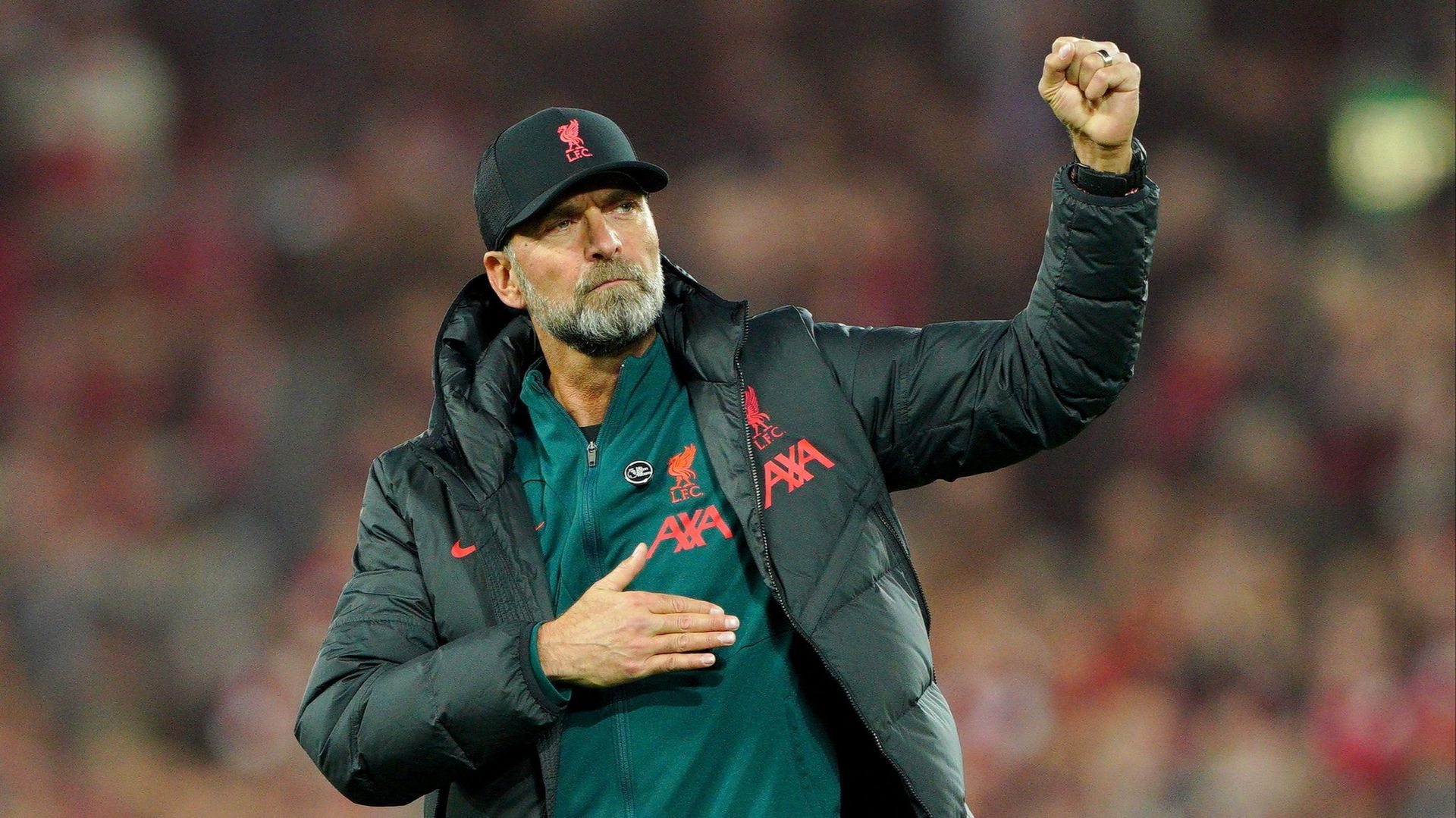
In an era short on admired leaders, Jürgen Klopp has been a rare role model. The German football manager, who announced today that he is resigning at the end of this season after nine years at Liverpool, offers numerous lessons for his counterparts in business and politics.
First, he turned himself into the embodiment of the institution he led. He always presented himself not as a mere technocrat but as somebody who loved Liverpool FC. Having joined the club as an outsider, he worked to understand what it meant to everyone involved in it. In his hugs and emotional sprints along the touchline (and sometimes into the field), the giant with football’s most joyous smile expressed the feelings of every Liverpool fan.
When the club won its first English league title in 30 years in 2020, he said, “I never could have thought it would feel like this, I had no idea,” and cried. He told Liverpool’s supporters: “It is a joy to do it for you.” He probably wasn’t faking it, giving that he has kept up the act practically daily since 2015. He understands that the whole point of professional football is shared communal emotion.
Second, he treated his players and staff as humans, not as mere instruments for his own success. When one staff member was unaware that full-back Andy Robertson would soon become a father for the first time, Klopp asked: “How can you not know that? That is the biggest thing in his life now.”
Klopp wanted to know everything about his players — “who they are, what they believe in, how they’ve reached this point, what drives them, what awaits them when they depart training.” And he meant it: “I don’t pretend I’m interested, I am interested.”
Klopp is often praised as a motivator, but in fact few top-class footballers need motivation. His man-management was more sophisticated than that. His understanding of people helped him find the right words in clear, simple and cliché-free English, his second language. In 2019, after a 3-0 defeat in the first leg of the Champions League semi-final at Barcelona, he bounded smiling into Liverpool’s deflated changing-room shouting, “Boys, boys, boys! We are not the best team in the world. Now you know that. Maybe they are! Who cares? We can still beat the best team in the world. Let’s go again.” Before the return leg at Anfield, he told his players: “Just try. If we can do it, wonderful. If not, then fail in the most beautiful way.”
He was lifting his men while also lifting the pressure: he gave them permission to fail. Instead, in perhaps the most breathtaking match of his tenure, they won 4-0, and went on to clinch the Champions League. His Liverpool lost two other Champions League finals. With a touch more luck, their achievement could have been generational. But even at the leanest moments, all the constituencies that make up a club — owner, players, staff, fans, media — wanted him around. Klopp made ruthless decisions without making enemies.
Another leadership lesson: he could delegate. A football manager today is less autocrat than chief executive, overseeing a staff of dozens. Klopp provided the guiding vision, of a pressing game played at frenzied pace: “It is not serenity football, it is fighting football — that is what I like . . . Rainy day, heavy pitch, everybody is dirty in the face and they go home and can’t play football for the next four weeks.”
He left most of the detail to specialists. For years he outsourced much of his training and match tactics to his assistant, Željko Buvač, whom Klopp called “the brain” of his coaching team.
Klopp was so obviously the leader, an Alpha male blessed with empathy, that he felt secure enough to listen to others and admit error. In 2017, when Liverpool needed a striker, the club’s data analysts lobbied him to sign the Egyptian Mo Salah. Klopp preferred the German forward Julian Brandt. It took time, but eventually Klopp was persuaded to buy Salah. The Egyptian became arguably Liverpool’s most important player. Klopp later apologised to the analysts for his mistake.
In a profession that attracts many megalomaniacs and then places them under inhuman stress, he was rare in never taking himself too seriously. He had views outside football — for leftwing politics, against Brexit — but he rejected the temptation to cast himself as a universal leader. When Covid-19 was spreading in early 2020, and a journalist fished for his views, he said experts should speak, not “people with no knowledge, like me . . . I don’t understand politics, coronavirus . . . I wear a baseball cap and have a bad shave.”
His last leadership lesson: leave at the right time, with dignity. Today he explained his resignation: “I came here as a normal guy. I am still a normal guy, I just don’t live a normal life for too long now. And I don’t want to wait until I am too old to have a normal life, and I need, at least, to give it a try.”
He also admitted fallibility, with a typically well-chosen metaphor: “I am a proper sports car, not the best one, but a pretty good one, can still drive 160, 170, 180 miles per hour, but I am the only one who sees the tank needle is going down.” It was a message to every failed leader currently clinging grimly to power.
Follow Simon @KuperSimon and email him at [email protected]