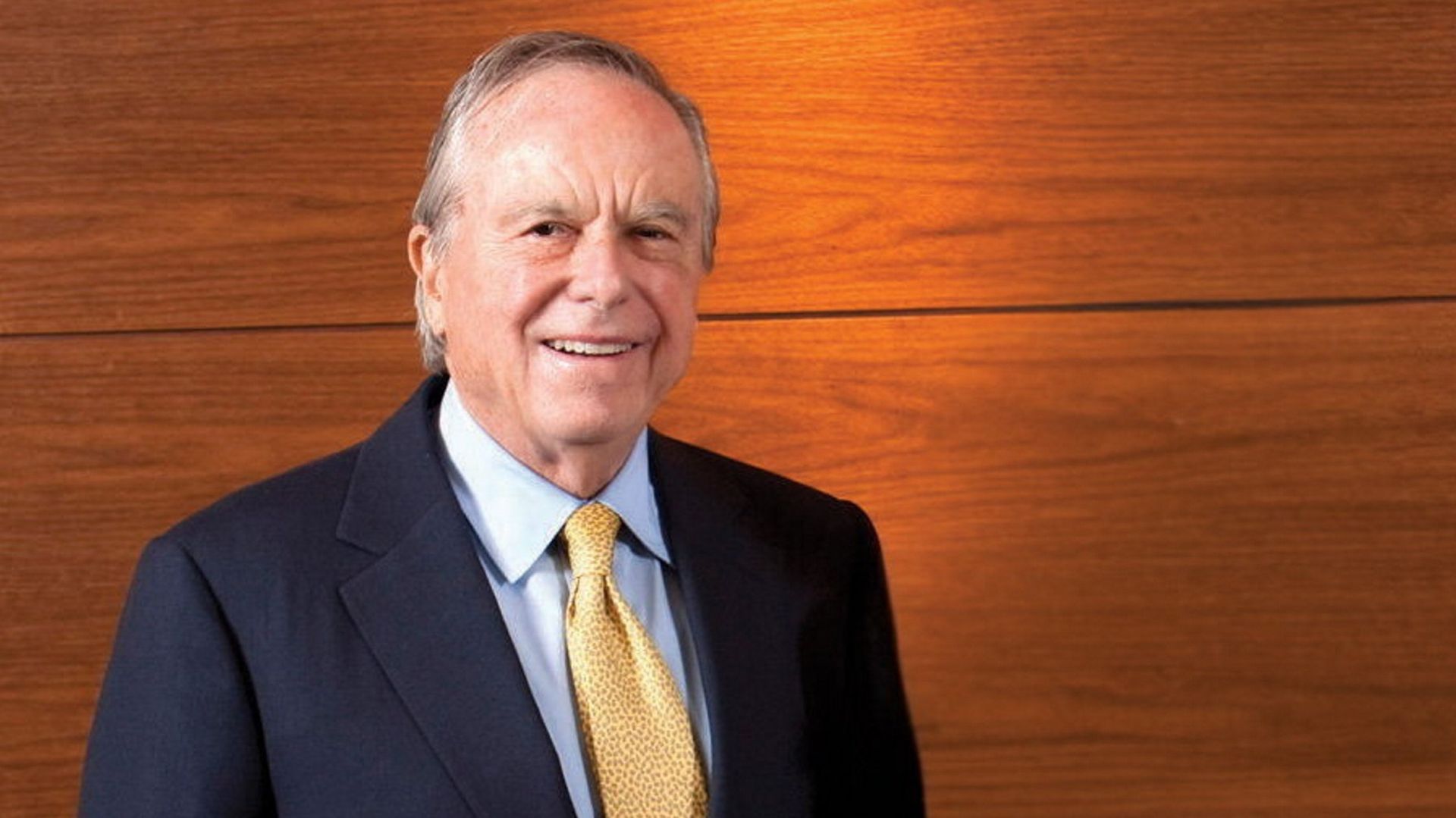
Sanford “Sandy” Robertson, the pioneering Silicon Valley financier whose initial public offerings helped turn a sleepy Northern California peninsula into a global economic powerhouse, has died at age 93.
Robertson was one of the earliest bankers to sense the potential of technological innovations emerging from the suburbs south of San Francisco in the 1970s and 1980s, at a time when major New York investment banks evinced little interest in the high-risk and little-known inventions that would come to dominate every aspect of modern life.
He and a handful of like-minded money men launched boutique investment banks catering to the emerging industry, collectively becoming known as the so-called Four Horsemen firms that dominated technology stock market listings for almost three decades. Robertson’s firm, Robertson Stephens, went on to underwrite hundreds of technology companies, some of which would ultimately become household names: Pixar Studios, eBay, E*Trade, AOL and Dell among them.
Frank Quattrone, whom Morgan Stanley sent in the 1980s to the Bay Area in pursuit of tech mandates, recalled Robertson’s stature.
“I admired him a great deal and he served as an inspiration for me to dedicate my career to tech banking,” Quattrone said in an email.
Robertson introduced Tom Perkins and Eugene Kleiner at a 1972 breakfast meeting in Palo Alto where the pair decided to launch a venture capital firm together. That firm, Kleiner Perkins, would go on to become the perhaps the most storied VC in history.
In 1995, Robertson Stephens led the IPO of Pixar, the animation studio. Years later, Stephens recalled the demands of Steve Jobs, the Pixar chief executive at the time, who offered precise views on the design of the prospectus and insisted on vegetarian-only meals during roadshow investor meetings.
After selling Robertson Stephens in the dotcom frenzy of the late 1990s, Robertson reinvented himself as both a private equity investor and close adviser to Salesforce co-founder Marc Benioff.
Sanford Richard Robertson was born in 1931 in Chicago. His father had acquired a restaurant during the depression and Robertson spent his childhood helping his parents operate it. “I had an MBA before I got out of high school,” he would quip.
Robertson had planned to attend the hotel management school at Cornell and return to the family business. But his father was able to sell the restaurant and instead Robertson went to the University of Michigan where he earned an undergraduate and masters degree concurrently in the early-1950s.
After three years in the US Navy, Robertson landed in Smith Barney’s corporate finance department. His coverage area included Nebraska, where at one point he helped a rising Omaha investor, Warren Buffett, take a large stake in American Express as the credit card company sought to recover from a scandal.
Robertson was set to take a spot leading Smith Barney’s office in Los Angeles but was instead sent to San Francisco to fill an unexpected hole. He was familiar with the city after landing in the Bay Area for a week’s stay upon his discharge from the navy.
His Smith Barney bosses expected him to be calling on the forestry companies, Chevron, and other old-line Northern California stalwarts. Instead, he believed the real action was 30 miles south of the city on the peninsula where the likes of Hewlett-Packard and Intel were ushering in the computing era.
“I realised the economic base of the city was the valley,” he later said.
In 1968, Robertson broke off from Smith Barney to co-found Robertson, Colman and Siebel, a firm established to do trading and banking strictly for the technology sector. Thomas Weisel, another promising San Francisco banker, joined a few years later. But a conflict with Weisel would set off Robertson to form another firm, Robertson Stephens.
Weisel would rebrand the previous firm Montgomery Securities. The Four Horsemen — Robertson Stephens, Montgomery Securities, Hambrecht & Quist and Alex. Brown & Sons — would go on to dominate technology dealmaking with their tight relationships in the clubby California tech scene.
“Sandy never raised his voice, never needed to pound the table and never oversold,” said Larry Sonsini, the eminent Silicon Valley lawyer.
Stock trading remained a lucrative activity with wide spreads, and the firms carried large equity research staffs at a time when IPOs were considered the crowning achievement for growing companies.
The late 1990s brought threats and opportunities. The Wall Street bulge-bracket firms by then had realised the opportunity in Silicon Valley. Goldman Sachs, Morgan Stanley, Credit Suisse First Boston and others would establish massive offices across San Francisco as well as south in Palo Alto and Menlo Park.
At the same time, a frenzied stock market allowed Robertson and the others to capture the value they created, even if it meant their firms would be subsumed into behemoths.
In 1998, Bank of America acquired Robertson Stephens for $530mn. But the firm ended up in the hands of Fleet Bank and eventually shuttered in 2002.
Robertson had left by 1999. With a Robertson Stephens colleague, he then set up Francisco Partners, a technology PE firm that today manages more than $40bn.
Around the same time, Robertson met Benioff, an Oracle executive, who had set up a company that offered a new business model, renting software to customers rather than selling licences.
Benioff’s start-up, Salesforce.com, had less than $100mn in revenue when Robertson joined as an adviser and director. Eventually, Salesforce went public and Robertson served on its board until 2023 when its revenue approached $35bn.
Robertson and his then wife Jeanne, like Benioff, would become important benefactors of the hospital at the University of California, San Francisco. Politics also rose as an important outlet for Robertson who counted fellow San Franciscans, Nancy and Paul Pelosi, as close friends.
Robertson had been a life-long Republican until he met Bill Clinton in 1992 at an event at Apple where the Democratic Arkansas governor’s commitment to the North American Free Trade Agreement impressed him. Robertson hosted a fundraiser for Clinton soon thereafter, with the festivities spilling into the wee hours at Robertson’s home in the Russian Hill neighbourhood of San Francisco.
Robertson was a listed producer of nearly 30 Broadway shows including Hamilton, taking in the details of seats sold at what price. He also raised racehorses.
Benioff said Robertson was obsessed with understanding how to identify successful ventures whether they were start-ups, theatre productions or thoroughbreds. “He really loved winners.”
Robertson is predeceased by wife, Jeanne. He is survived by wife Nancy, three daughters, six grandchildren and two great grandchildren.