The Earth’s energy imbalance reached record levels last year, as the rate of solar radiation that entered the planet exceeded the amount leaving the system at a faster rate, the World Meteorological Organization said.
The measure was included for the first time in the UN agency’s State of the Climate annual report, as the rate had more than doubled in the past 20 years while greenhouse gases continued to accumulate.
Under a balanced system, incoming heat from the sun is about the same as outgoing energy. The levels are measured by satellite data, collected since 2000, as well as a host of land, ice and sea monitors used since 1960.
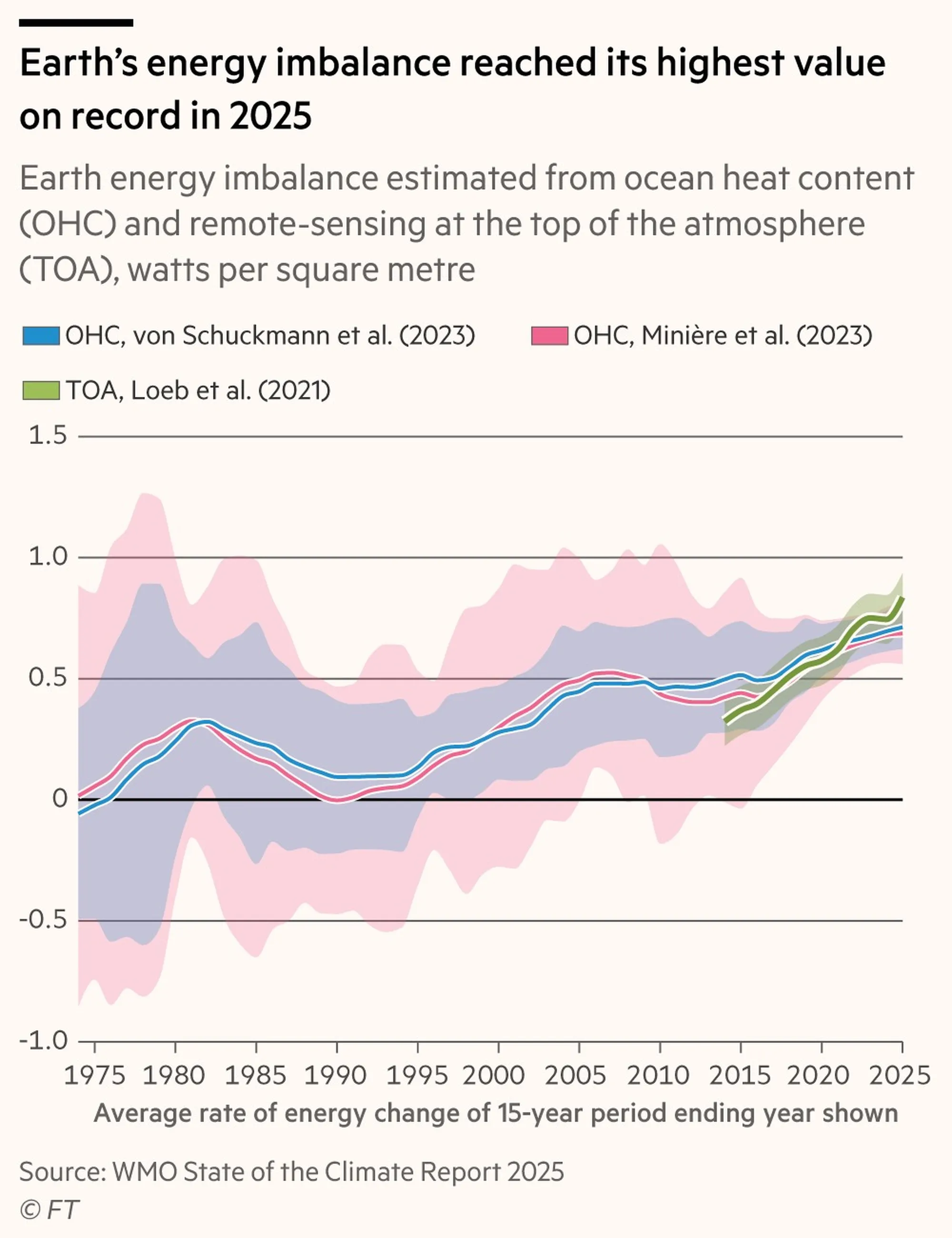
The oceans had absorbed most of the excess heat, storing about 91 per cent of the energy. Another 5 per cent had warmed the land, 3 per cent heated the ice and 1 per cent warmed the air, the report said.
The 2015-2025 period was the warmest 11 years since observations started, with ocean heat and acidification at record levels, and continuing rises in sea levels and the retreat of glaciers.
In 2025, ocean heat reached the highest level in the observational record, beating the previous high set in 2024.
Karina von Schuckmann, ocean scientist at French research group Mercator Ocean International, said there were not yet signs of the oceans weakening as a heat sink, but the warmth had increased in deeper layers.
This meant the heat now stored at lower levels was likely to have been “captured” for hundreds or thousands of years, she said.
Ocean warming is measured in zettajoules, and the data showed more than 11ZJ of heat energy had been added annually since 2005 — estimated as the equivalent of 18 times the total human energy use for one year.
“These are huge quantities of energy — the 2025 increase alone was about 39 times the annual human energy use,” explained John Kennedy, lead author of the report.
The authors noted that apart from rising greenhouse gases, other contributors to stored heat in the planet were reduced aerosols in the atmosphere, less solar reflection from reduced ice coverage and less long-wave radiation emitted to space from the top of the Earth’s atmosphere because of trace gases and water vapour.
WMO deputy secretary-general Ko Barrett said that despite concerns about cuts in climate science funding — led by the Trump administration — “we’re seeing that actually a lot of that funding was put back into budgets. So the challenge is not as dire as we would have worried about.”
“We’re not seeing any kind of a sign that would point to a decline in interest in the information that we’re providing or even in a decline in contributions to the report,” she said.
If anything, Barrett added, there was greater demand for its data and credible information on climate change.
Climate Capital
Where climate change meets business, markets and politics. Explore the FT’s coverage here.
Are you curious about the FT’s environmental sustainability commitments? Find out more about our science-based targets here